What Is a Cleanroom?
A cleanroom is a controlled environment designed to limit airborne particles, contamination, temperature, humidity, pressure, and airflow. STJH Cleanroom helps manufacturers build cleaner, safer, and more stable production environments.
Back to HomeA controlled space for cleaner production
In ordinary rooms, dust, microorganisms, fibers, chemical vapors, and other invisible contaminants can move freely through the air. For industries such as pharmaceuticals, electronics, biotechnology, medical devices, laboratories, and precision manufacturing, these contaminants may affect product quality, safety, and production yield.
A cleanroom solves this problem by using professional air filtration, controlled airflow, sealed construction, and strict operating procedures. The goal is to create a cleaner and more stable environment for critical work.
How does a cleanroom work?
A cleanroom works by continuously supplying filtered air into the room and removing contaminated air through return air systems. High-efficiency filters, such as HEPA or ULPA filters, capture extremely small airborne particles before the air enters the controlled area.
Air Filtration
HEPA or ULPA filters remove fine particles from the air and help maintain the required cleanliness level.
Airflow Control
Proper airflow design helps dilute, remove, and prevent the accumulation of airborne contamination.
Pressure Control
Positive or negative pressure can be used to prevent contaminants from entering or leaving a controlled area.
Temperature & Humidity
Environmental control improves comfort, process consistency, and product protection.
Why are cleanrooms important?
Even a tiny particle can cause defects in microelectronics, contamination in pharmaceutical production, or quality problems in precision manufacturing. Cleanrooms reduce these risks by creating a stable, measurable, and controlled production environment.
Common cleanroom applications
Cleanroom classification
Cleanrooms are usually classified according to the number and size of airborne particles allowed in a specific volume of air. Common standards include ISO 14644-1, which defines cleanroom classes such as ISO Class 5, ISO Class 6, ISO Class 7, and ISO Class 8.
| Cleanroom Class | Typical Application | Cleanliness Level |
|---|---|---|
| ISO Class 5 | High-precision or critical processes | Very high cleanliness |
| ISO Class 6 | Electronics, medical, laboratory areas | High cleanliness |
| ISO Class 7 | Pharmaceutical and general clean production | Controlled cleanliness |
| ISO Class 8 | Packaging, assembly, and support areas | Basic cleanroom control |
What makes a good cleanroom?
Need a cleanroom solution?
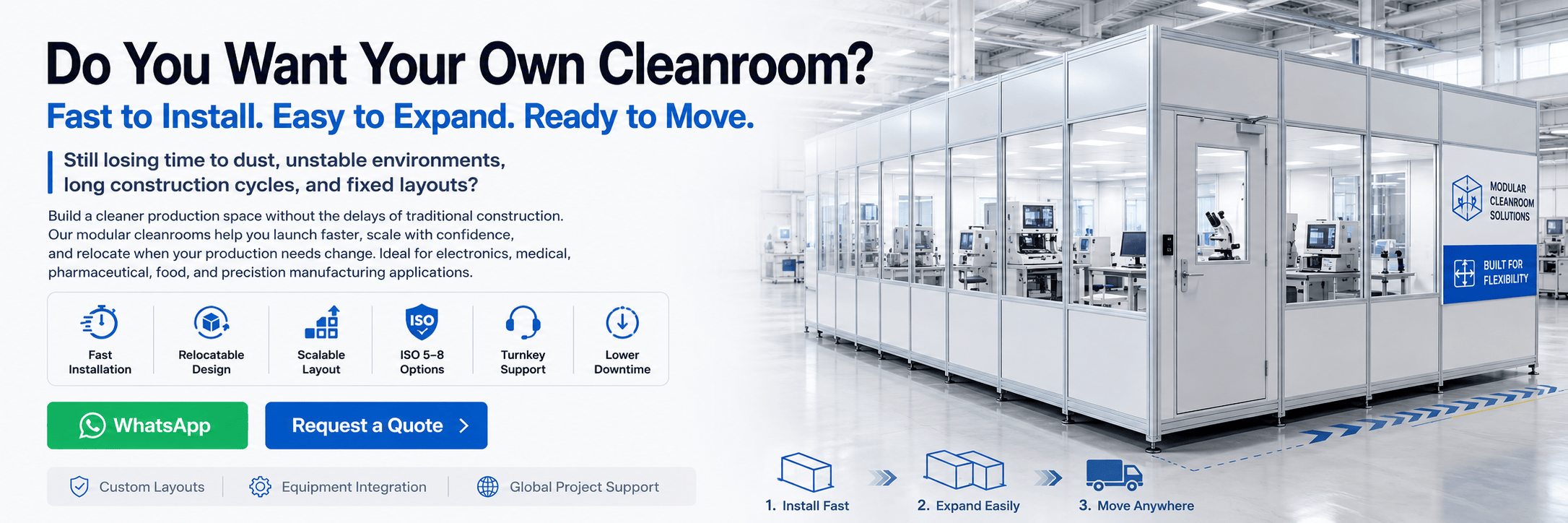
STJH Cleanroom provides modular cleanroom design, cleanroom construction, clean booth solutions, and cleanroom supporting systems for different industries.